Wood species100 Wood species →
Understanding wood17 Understanding wood →

Calculations and sizes

Care & finishing28 Care & finishing →
Choosing & buying16 Choosing & buying →
Build it yourself51 Build it yourself →
Trees & forests31 Trees & forests →
To the Wood Guide home page →

What is Douglas fir? Properties, uses and durability

The Wood Guide · The wood register

Softwood · from our workshop

Douglas fir

There are woods you use, and woods you feel. Douglas fir belongs to the second kind: strength, character and outdoor durability in one material.

  • Pseudotsuga menziesii
  • Durability class 3 · 10–15 years
  • Weathers to an even silver grey
Pseudotsuga menziesii
Douglas fir (Pseudotsuga menziesii)Douglas firPseudotsuga menziesii
Douglas fir log section: orange-brown heartwood, narrow pale sapwood band (Pseudotsuga menziesii)
Douglas fir log section: orange-brown heartwood, narrow pale sapwood bandPseudotsuga menziesii
Planed Douglas fir: warm tone with a tight, straight grain (Pseudotsuga menziesii)
Planed Douglas fir: warm tone with a tight, straight grainPseudotsuga menziesii
Summary

Douglas fir at a glance

Not the hardest, not the softest — but one of the most complete softwoods you can choose. Stronger than spruce, cheaper than oak, more stable than larch.

What makes Douglas fir special is its strength-to-weight ratio. It is lighter than hardwood but performs close to it — which is why you see it in large spans: carports, pergolas, verandas. And it is one of the few softwoods that you can leave untreated outdoors in our climate without having to replace it after three years.

What we build from it

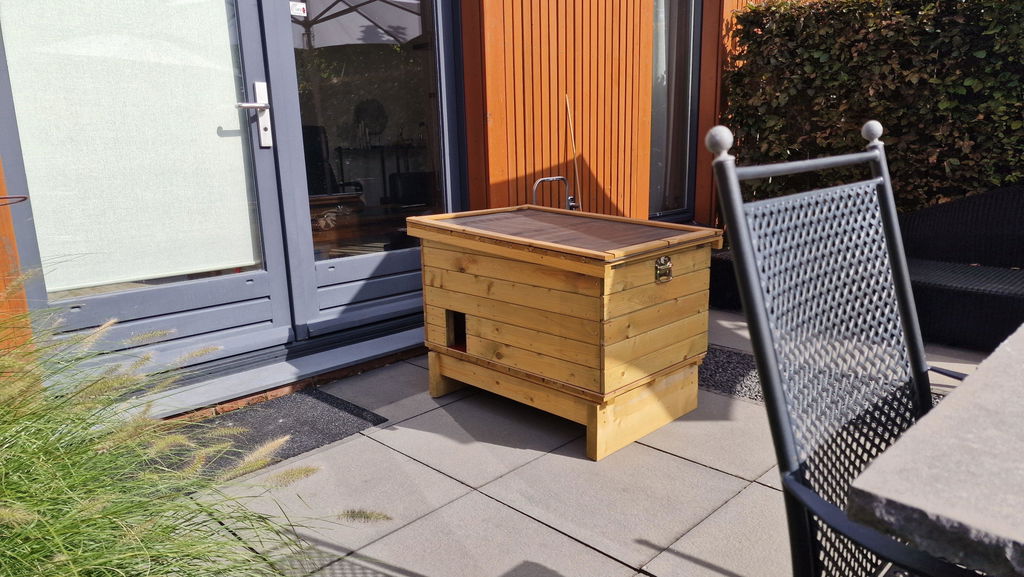
Our Douglas fir garden benches, garden sets, outdoor kitchens and planters. All from heartwood — the part of the trunk that actually lives up to that class 3.

Botanical
Pseudotsuga menziesii (Douglas fir)
Heartwood
orange to rust brown, sometimes pinkish
Density
470–550 kg/m³ (at 12% moisture)
Hardness
2,760–3,100 N (Janka)
Outdoors
class 3 — 10–15 years, often 20+
Maintenance
virtually none, unless you want to keep the colour
Price range
mid-range

To be fair: in warm weather resin can bead out of a knot — "bleeding", as the trade calls it. Wipe it off and you're done, but you should know.

In pictures · Douglas fir, from wild giant to garden bench1 / 8
From wild giant to European classic

Up to more than 100 metres tall

In the wild, Douglas fir grows in western North America, from British Columbia to northern California: 70 to more than 100 metres tall, some specimens 500 to 1,000 years old. In 1827 David Douglas sent the first seeds to Europe; from 1850 Douglas fir was planted on a large scale in Belgium, the Netherlands, France and Germany.

Click a chapter or use the arrows · tree, growth rings and greying schematic, time speeded up.

The tree

From wild giant to European classic

Douglas fir is not a true fir, not a pine and not a larch — it forms a genus of its own.

In the wild it grows in western North America, from British Columbia to northern California. There it reaches 70 to more than 100 metres, with dead-straight trunks, and some specimens live 500 to 1,000 years.

In 1827 the Scottish botanist David Douglas — after whom the tree is named — sent the first seeds to Europe. What began as a curiosity in English estate woodlands grew into one of the continent's most important softwoods. From 1850 onwards Douglas fir was planted on a large scale in Belgium, the Netherlands, France and Germany.

European Douglas fir is often the better one

Thanks to the temperate climate and longer growing seasons you get finer growth rings, more even wood and fewer resin pockets than with American Douglas fir. It is slightly lighter but keeps all its strength. What's more, more and more Douglas fir comes from local forests — a shorter chain, a smaller footprint.

The face of Douglas fir

Appearance, scent and greying

Douglas fir has a face you don't soon forget — and it changes over the years.

Colour with contrast

Warm orange-reddish brown to rust-brown heartwood, sometimes with a hint of pink or amber. The sapwood is lighter: yellowish white to light brown. You often see both in boards — that contrast gives character.

Grain and growth rings

Straight to slightly wavy, with clear, regular rings. European Douglas fir usually has 3 to 6 per centimetre. The closer the rings, the slower the growth and the harder the wood.

Resin and scent

Natural resin canals contribute to its durability. Small resin pockets or streaks are not a defect but a sign of authenticity — and freshly sawn, Douglas fir smells slightly sweet and resinous.

Greying: its second life

Leave Douglas fir untreated outdoors and it starts to change colour after three to six months. UV radiation breaks down the lignin and the wood takes on a silver-grey patina. After one to two years the change is complete.

Fresh — warm reddish brown After 1–2 years — even silver grey

Many people find the grey more beautiful: calmer, more neutral, more timeless. It suits clean-lined architecture and country romance alike. And every board greys slightly differently — depending on orientation, sun and rain — so you get subtle variation instead of monotony.

The figures

Technical properties

With what each value means in practice — figures without explanation say nothing.

Property Value What that means in practice
Density (12% moisture) 470–550 kg/m³ Lighter than oak, heavier than spruce: easy to work and sturdy enough for construction
Durability class heartwood Class 3 (EN 350) Untreated above ground 10–15 years; with good ventilation and drainage often 20 years or more
Strength class C24 to C30 (EN 338) Excellent for load-bearing structures: beams, rafters, frames, floors
Hardness (Janka) 2,760–3,100 N Harder than larch and clearly harder than spruce — resists wear well
Bending strength 78–92 N/mm² Deflects less readily than other softwoods; ideal for spans and decking
Compressive strength parallel to grain 40–50 N/mm² Holds up well under vertical load: columns, uprights, posts
Volumetric shrinkage 11–13% Moderate shrinkage; very stable once dried to 12–15% moisture
Modulus of elasticity 11,000–13,000 N/mm² Stiff enough for floors and stairs without a springy feel

Douglas fir next to other species

Property Douglas fir Larch Spruce Oak
Outdoor durability Class 3 (10–15 years) Class 3–4 (8–12 years) Class 4 (5–8 years) Class 2 (15–25 years)
Strength class C24–C30 C18–C24 C16–C24 D40–D50
Density 470–550 kg/m³ 550–590 kg/m³ 430–470 kg/m³ 650–720 kg/m³
Greying Even silver grey Grey with brown patches Uneven grey Silver grey
Workability Excellent Good Very good Good, but heavy

Read also Douglas fir or hardwood, or larch or Douglas fir for the detailed comparison.

Uses

Where Douglas fir shines

Indoors and outdoors, with a practical point of attention for each use.

Decking and boardwalks

Wide boards that feel warm underfoot. Choose at least 28 mm thickness; fixing from underneath gives a neater finish.

Garden furniture

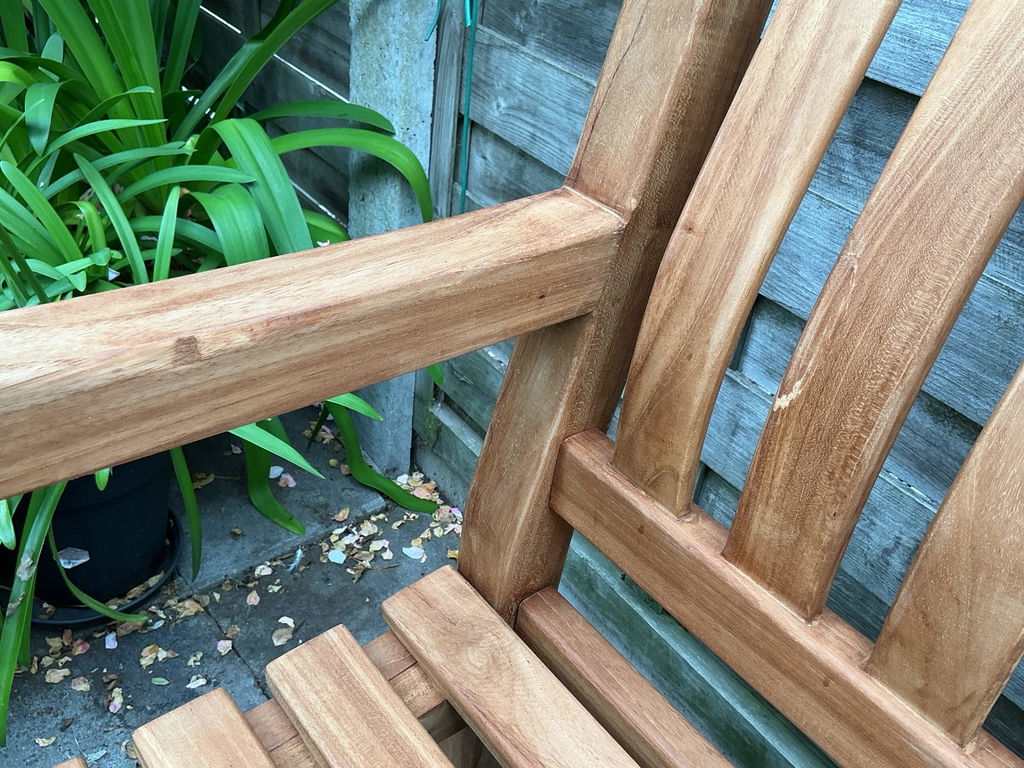
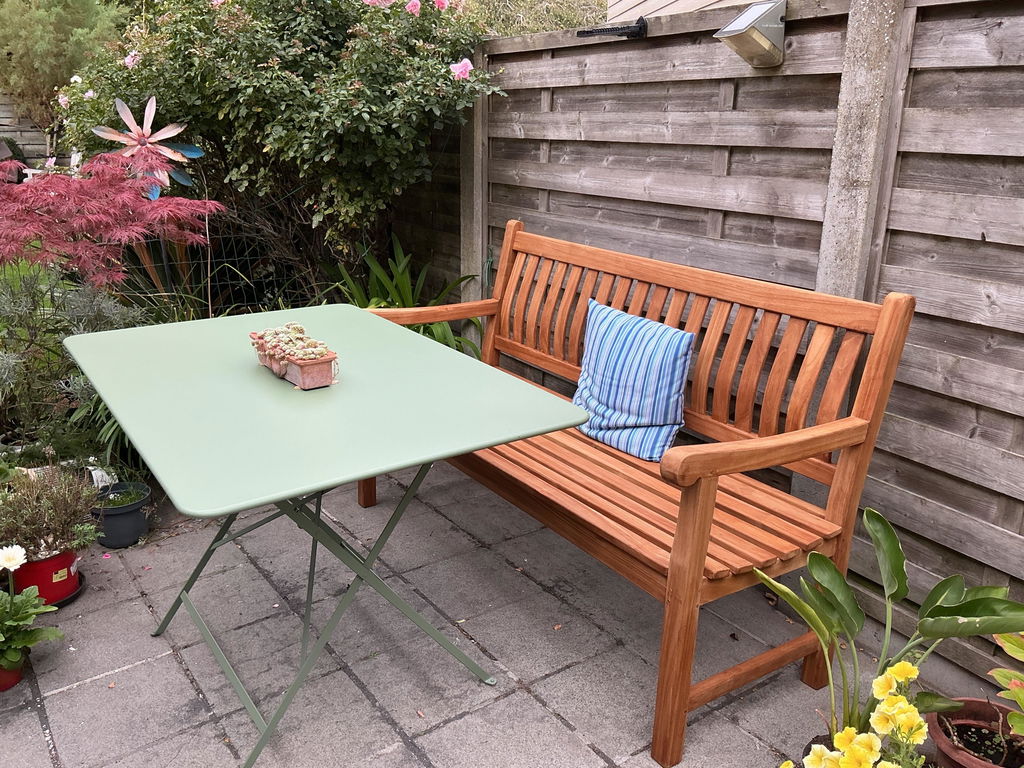
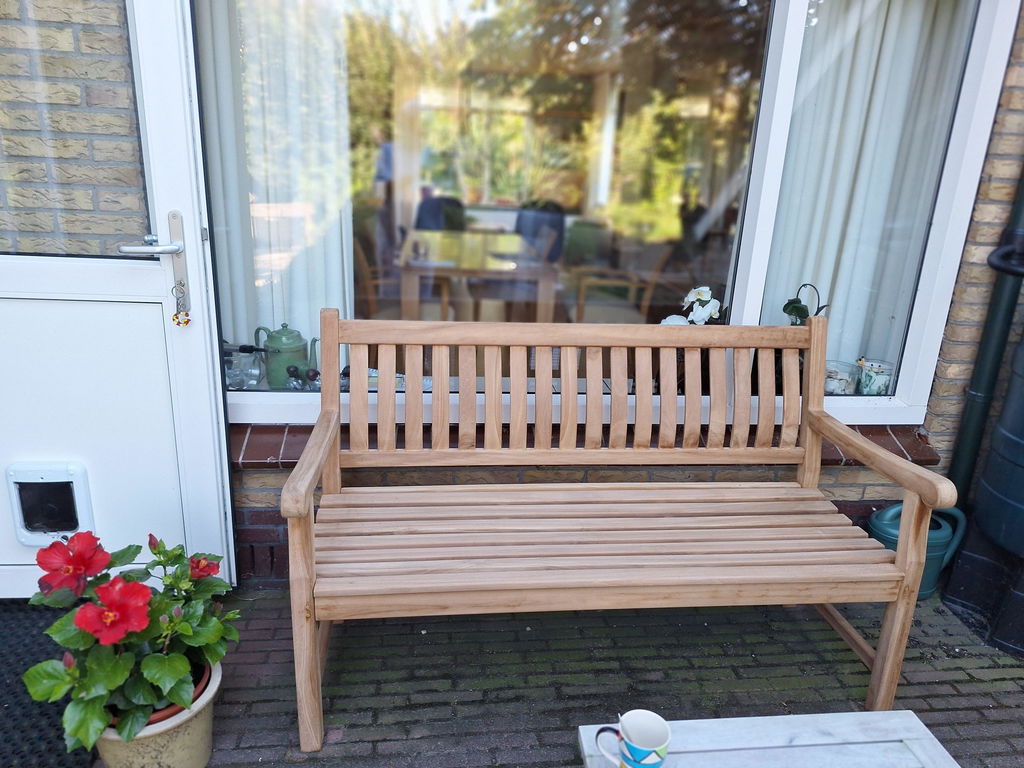
From sturdy tables to elegant benches. Douglas fir keeps its shape, weathers beautifully and asks little. Browse the Douglas fir range.

Cladding

Vertical or horizontal boards that grey beautifully. Use heartwood and provide at least a 20 mm ventilation cavity behind it.

Pergolas and carports

Beams of 70×170 or 90×190 mm for large spans; strength class C24 allows 4 to 6 metres.

Fences and gates

Battens, boards or posts. Use class 3 heartwood and always keep posts out of ground contact, on concrete footings or metal post anchors.

Play equipment

Safe, low in splinters and weather-resistant. Rounded corners and a smooth finish make it child-friendly.

Floors and stairs

Warm, sturdy boards. Use well-dried wood (12–15% moisture) and finish with hardwax oil or UV lacquer.

Wall cladding and beams

Vertical boards make a room look taller, horizontal ones wider. Exposed beams give a country or industrial feel.

What Douglas fir is not good for

  • Direct ground contact. Class 3 is not suitable for permanent contact with damp soil. Use class 1–2 wood, or put Douglas fir on concrete footings and steel anchors.
  • Permanently under water. For sheet piling and quay walls you choose azobé or steel.
  • High-precision cabinetmaking. For veneer or instrument making, evenly grown hardwoods are more stable. Douglas fir is strong, not fine.
From our range

Douglas fir in the garden

From complete garden sets to outdoor kitchens and planters — all in European Douglas fir heartwood.

Outdoor kitchens in Douglas fir

Douglas fir works well with composite worktops or stainless steel appliances, and ages elegantly without giving way. See also the flower and plant boxes.

Two ways

How Douglas fir stays beautiful — or becomes more beautiful

You have the choice: keep the warm colour, or let it grey. Both are fine. It depends on your taste and the time you want to spend on it.

Option 1 · the least work

Let it grey naturally

  • UV light breaks down the lignin; after one to two years the silver grey is complete.
  • Maintenance: rinse once a year with water and a soft brush.
  • Advantage: virtually maintenance-free, timeless look.
  • Drawback: some people find grey less warm than the original reddish brown.
Option 2 · a yearly coat

Keep the warm colour

  • Treat with wood oil or a transparent stain with a UV filter.
  • Once a year; for the first treatment two coats with drying in between.
  • Do it in spring or early summer, in dry weather between 10 and 25 °C.
  • Drawback: it needs attention every year.

Solving problems

Green algae

Normal on weathered wood. Brush off with water and a soft brush, or use a biodegradable algae remover.

Black spots

Mould caused by poor ventilation. Remove with a vinegar solution (one part vinegar to one part water), let it soak in and rinse off — and improve the ventilation behind or under the wood.

Resin bleed

Can occur on fresh wood. Remove with white spirit, let it dry and then treat with oil.

Quick answer

Frequently asked questions about Douglas fir

How long does Douglas fir last outdoors?

The heartwood reaches durability class 3: untreated and above ground usually 10 to 15 years. With good construction details — ventilation and drainage — often twenty years or more.

Do I need to treat Douglas fir?

Not if you let it grey; rinsing once a year is then enough. If you want to keep the warm reddish-brown colour, treat it every year with wood oil or a transparent stain with a UV filter.

Why does Douglas fir grey so evenly?

UV light breaks down the lignin in the wood. Douglas fir does this more evenly than larch or spruce, so you get an even silver grey instead of patches. After one to two years the change is complete.

Can Douglas fir go in the ground?

No. Class 3 is not suitable for permanent contact with damp soil. Put posts on concrete footings or steel anchors, or choose a species in class 1 or 2.

Is European Douglas fir better than American?

For our uses, usually yes. The temperate climate and longer growing seasons give finer growth rings, more even wood and fewer resin pockets. It also comes from a shorter chain.

What is the difference with hardwood?

Hardwood is denser, heavier and naturally more durable; Douglas fir is lighter, cheaper and easier to work. The full trade-off is in Douglas fir or hardwood.

More in The Wood Guide

Compare Douglas fir

Douglas fir is one of the twelve species in our register — and often the smart middle way.

Have a question about your project? Just ask — we're happy to help.

Pseudotsuga menziesii — Lumbar, Public domain · Pseudotsuga menziesii — Jean-Pierre Chéreau & Roger Culos, CC BY-SA 3.0 · Photo via Wikimedia Commons: Pseudotsuga menziesii — Joe Mabel, CC BY-SA 4.0