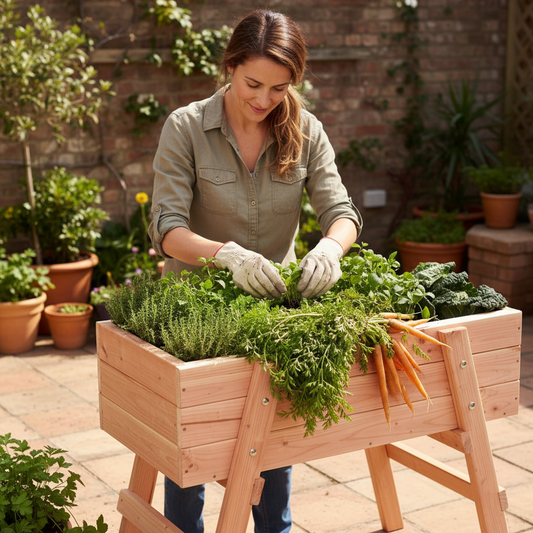
What Is Douglas Wood — and Why Does It Work Outdoors?
Douglas fir (also known as Oregon Pine) is a close-grained, naturally oily softwood whose built-in resin slows moisture uptake more effectively than most softwoods. Left untreated it weathers to a calm silver-grey; oiled once or twice a year it holds its warm reddish-brown tone for decades. Our guide on what Douglas wood is and how it performs covers grain, durability class and finishing options in full. Curious about the naming? See how European Douglas compares to Oregon Pine.
What's in the Collection
Douglas or Hardwood — Which Should You Choose?
Douglas is a strong all-rounder for garden furniture, structures and planters. It is noticeably lighter than tropical hardwoods, easy to work with, and takes oils and stains cleanly. If your priority is a surface that shrugs off heavy daily use in full sun — think a main dining table out every single summer day — teak or acacia hardwood will edge it out on raw surface hardness. For a head-to-head breakdown, read our article on the difference between Douglas and hardwood. Also weighing up larch? Our guide on larch versus Douglas covers the key differences clearly.
| Property |
Douglas fir |
Teak / Acacia |
| Weight |
Light — easy to move and reposition |
Heavy — very stable once placed |
| Natural oil content |
High for a softwood |
Very high (especially teak) |
| Surface hardness |
Medium |
High |
| Untreated weathering |
Even silver-grey patina |
Even silver-grey patina |
| Typical use |
Dining tables, benches, planters, outdoor kitchens |
Loungers, dining sets, heavy-use tables |
Maintenance — Practical and Straightforward
| Task |
Frequency |
What to use |
| Brush off dirt and debris |
As needed / after storms |
Soft brush, lukewarm water |
| Deep clean |
Once per season |
Mild wood cleaner, rinse thoroughly |
| Oil or treat (to keep warm colour) |
Once or twice per year |
Colourless or tinted exterior wood oil |
| Winter cover or storage |
Before first frost |
Breathable furniture cover or dry indoor space |
Prefer the natural silver-grey look? Skip the oil entirely — Douglas weathers evenly without losing structural strength. Either way, avoid letting water pool on flat surfaces and keep good airflow under planters and bench feet.
Frequently Asked Questions
Is Douglas wood suitable for the Swedish climate?
Yes. Douglas fir's natural resin content slows moisture absorption, which means it handles the freeze-thaw cycles of a Swedish winter better than most softwoods. Furniture left outside should ideally be covered or moved to a sheltered spot before the first hard frost, but the timber itself is well-adapted to cold and wet Nordic conditions.
Does Douglas outdoor furniture need treating before first use?
Not necessarily. You can put Douglas furniture straight outside untreated and it will gradually develop a silver-grey tone that many owners find very attractive. If you prefer to keep the warm reddish-brown colour, apply a quality exterior wood oil before the first season and repeat once a year. Our Douglas wood guide covers finishing options — including tinted oils and open-pore treatments — in more detail.
What other outdoor wood collections does E-woodproducts carry?
Alongside our Douglas outdoor range we stock teak garden furniture for maximum long-term durability, spruce wood products as a lighter-budget alternative, and a curated selection in our featured products overview. Not sure which wood suits your situation? Our article on Douglas versus hardwood is a good starting point.