
Two families of wood, one fundamental choice — hardwood (left) vs. softwood (right)
Walk into any timber yard or browse any furniture catalogue and you will meet two words almost immediately: hardwood and softwood. The distinction sounds obvious — one is hard, the other soft — but the reality is more interesting, and frankly more useful, than that. A piece of balsa wood is classified as a hardwood yet you can dent it with a fingernail. Meanwhile, yew — a softwood — is tough enough to have been the English longbow's timber of choice for centuries.
Understanding what actually separates these two groups helps you pick the right material for outdoor furniture, construction, or a weekend DIY project. This guide walks you through the science, the practical consequences, and where each wood type genuinely earns its place.
If you already know you want long-lasting garden furniture and are weighing up hardwood options, take a look at our acacia and meranti pieces — a good starting point while you read on:
The botanical root of the classification
The hard/soft divide is not actually about physical hardness at all — it is a botanical classification based on how the tree reproduces:
- Hardwood comes from angiosperms (flowering plants with enclosed seeds) — typically broad-leaved, deciduous trees such as oak, beech, teak, acacia and mahogany.
- Softwood comes from gymnosperms (cone-bearing plants with naked seeds) — almost always evergreen conifers such as pine, spruce, larch, cedar and Douglas fir.
This reproductive difference drives everything else: cell structure, growth rate, density, workability and natural durability. Understanding that chain of causation makes the rest of the comparison click into place.
Curious how a specific conifer stacks up against broadleaf species? Read our deep-dive on Douglas fir versus hardwood.
Common species at a glance
Hardwood species
- Oak (Quercus spp.) — robust, tannin-rich, excellent outdoor longevity
- Beech (Fagus spp.) — strong, flexible, widely used for interior furniture
- Maple (Acer spp.) — light-coloured, hard-wearing, popular for flooring
- Teak (Tectona grandis) — naturally oily, outstanding weather resistance
- Acacia (Acacia spp.) — dense, attractive grain, sustainably fast-growing
- Mahogany (Swietenia spp.) — stable, decorative, prized for joinery
- Meranti (Shorea spp.) — versatile tropical hardwood, good strength-to-weight ratio
For a focused comparison between teak and other hardwoods, see our article on teak wood versus hardwood.
Softwood species
- Pine (Pinus spp.) — light, easy to machine, widely available
- Spruce (Picea spp.) — high strength-to-weight ratio, used in construction and music
- Larch (Larix spp.) — one of the more durable softwoods, used for cladding and decking
- Cedar (Cedrus spp.) — naturally fragrant, good decay resistance
- Douglas fir (Pseudotsuga menziesii) — strong, stable, popular for structural timber
Want to know how pine and spruce differ from each other? Our guide on pine versus spruce covers exactly that.
Side-by-side comparison
| Property |
Hardwood |
Softwood |
| Botanical origin |
Angiosperms (flowering trees) |
Gymnosperms (conifers) |
| Cell structure |
Complex — contains vessels (pores) |
Simpler — tracheid cells, no vessels |
| Typical growth rate |
Slow — 20 to 100+ years to maturity |
Faster — often 25–30 years |
| Typical density |
450–850 kg/m³ |
350–550 kg/m³ |
| Natural durability (outdoors) |
Often high — many species need no treatment |
Usually lower — impregnation or coating needed |
| Workability |
Can be harder to cut and machine |
Generally easier to cut, nail and plane |
| Typical applications |
Furniture, flooring, decking, joinery |
Construction, cladding, paper pulp, DIY |
| CO₂ storage per m³ |
Higher (greater density) |
Lower per m³, but faster forest regeneration |
Hardwood in practice: where it earns its reputation

A tree bench in solid hardwood — left untreated, it weathers to silver-grey over time
The dense, vessel-rich cell structure of hardwood has two big practical consequences: it resists moisture penetration better, and it holds screws and joints more firmly. For outdoor furniture that sits through a Danish winter and a full summer, those properties matter enormously.
Teak and acacia — the species behind most of our garden range — go a step further. Both contain natural oils that actively repel water and inhibit mould growth. Teak oil also makes the surface less hospitable to the UV degradation that turns cheaper timber grey and brittle within a few seasons.
Beyond gardens, hardwood is the go-to for hardwood flooring, staircases, boat decking, and any joinery where surface wear is a constant factor. The trade-off is that slower growth makes hardwood relatively scarce, and that scarcity is reflected in price and in the importance of responsible sourcing.
See also: more differences between hardwood and softwood — including a look at how impregnated softwood closes some of the gap.
Hardwood garden furniture — built to last
All pieces below are crafted from solid acacia or meranti hardwood — no veneers, no fillers.
Softwood in practice: speed, scale and workability
Conifers grow fast, grow straight, and grow in vast managed plantations across Scandinavia, Central Europe and North America. That combination makes softwood the backbone of the construction industry: roof trusses, floor joists, wall framing, and structural beams are almost universally softwood in the European market.
For garden use, softwood is most competitive when it has been pressure-impregnated — a process that forces preservatives deep into the wood fibres, dramatically extending service life. Impregnated pine or Douglas fir picnic tables and raised beds can perform well outdoors for well over a decade when maintained properly.
The other advantage is ease of working. Softwood cuts cleanly with standard tools, takes paint and stain readily, and is light enough for one person to handle long lengths alone. For school projects, fencing, and shelving, it is hard to beat on a practical level.
Not sure whether planed or rough-sawn timber is right for your project? Our article on planed versus finely sawn wood explains the difference clearly.
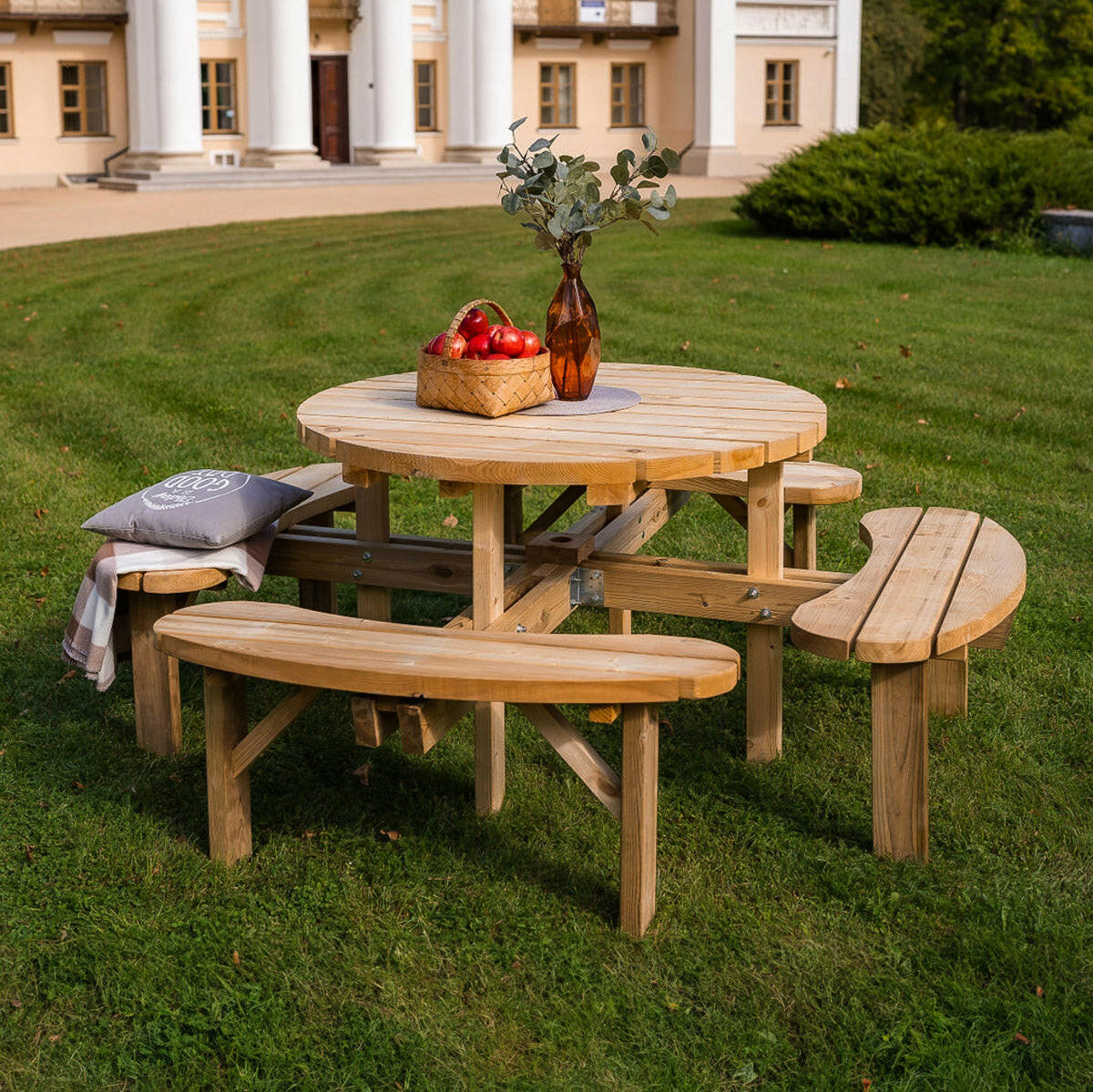
Impregnated softwood picnic table — good value, solid outdoor performance
Durability and maintenance: what to expect over the years
The maintenance burden is where the hardwood/softwood choice becomes very tangible for a furniture buyer:
- Untreated hardwood (teak, acacia): Wipe clean, oil once or twice a year with a suitable teak or wood oil, and the furniture will look good for decades. Skipping the oil does not destroy the wood — it simply allows it to grey gracefully.
- Untreated softwood outdoors: Without protection, moisture and UV will degrade the surface relatively quickly. Annual painting, staining or oiling is not optional — it is the maintenance contract you sign when you choose bare softwood outside.
- Impregnated softwood: The chemical treatment buys you several years before active maintenance is needed, making it a practical middle ground for items like raised beds and picnic tables that you do not want to fuss over every spring.
More hardwood pieces worth considering
Environmental considerations: neither wood is automatically "green"
Both hardwood and softwood can be produced responsibly or irresponsibly — the species and the sourcing chain matter far more than the botanical category.
- Hardwood: Slow growth means each tree represents a long-term carbon store. Durable hardwood furniture that lasts 30 years locks away that carbon and avoids the manufacturing footprint of repeated replacements. The risk is unsustainable logging of tropical forests — so the origin of tropical hardwood (teak, acacia, meranti) matters. Certification schemes such as FSC (Forest Stewardship Council) and PEFC provide independent verification that timber comes from responsibly managed forests. When buying hardwood, asking suppliers about forest of origin and any third-party verification is always worthwhile.
- Softwood: Fast rotation cycles mean forests can be replenished relatively quickly, which is why most European construction timber comes from certified softwood plantations. However, the chemical impregnation used to make softwood durable outdoors introduces substances that require careful handling at end of life.
- Acacia occupies an interesting middle ground — it is a hardwood that grows considerably faster than teak or oak, making it one of the more resource-efficient choices for solid hardwood furniture.
Frequently asked questions
Is hardwood always harder than softwood?
No — the names refer to botanical origin, not physical hardness. Balsa, for example, is one of the lightest and softest timbers in existence, yet it is botanically a hardwood. Conversely, yew (a softwood) is dense and tough. That said, as a general pattern, hardwoods tend to be denser and harder than softwoods — the exceptions are simply worth knowing about.
Which is better for outdoor garden furniture — hardwood or softwood?
For low-maintenance, long-lived garden furniture, naturally oily hardwoods like teak, acacia and meranti are the stronger choice. Their cell structure and natural oils resist moisture and UV without requiring annual treatment. Impregnated softwood is a solid budget-friendly option for items like picnic tables and raised beds, but does require more ongoing care.
Why does some hardwood furniture go grey outdoors?
UV radiation breaks down lignin — the natural "glue" that binds wood fibres — causing surface cells to die and turn grey. This is a surface-only process and does not affect structural integrity. You can prevent it by applying a UV-filtering wood oil annually, or simply accept the silver-grey patina, which many owners find attractive.
What does impregnated softwood mean, and is it safe?
Pressure impregnation forces a preservative solution deep into the wood fibres, protecting against rot, fungi and insects. Modern impregnation in the EU uses copper-based compounds (replacing the older chromium-arsenic treatments, which were banned). The treated timber is safe for normal outdoor contact once dry, though it should not be used for surfaces in direct contact with food or drinking water without specific approval.
How do FSC and PEFC certification work?
FSC (Forest Stewardship Council) and PEFC (Programme for the Endorsement of Forest Certification) are independent, internationally recognised schemes that audit forestry operations and timber supply chains. A product carrying an FSC or PEFC label has been verified — by an independent third party — as coming from a forest managed according to environmental, social and economic standards. When you see these logos on timber or furniture, it means the certification body (not the retailer) has inspected and approved the chain of custody from forest to finished product.
Is acacia a sustainable hardwood choice?
Acacia is generally considered one of the more resource-efficient tropical hardwoods. It matures faster than teak or oak, adapts to a range of growing conditions, and produces dense, durable timber well-suited to outdoor furniture. As with any tropical wood, the responsible choice depends on where and how the trees were grown — so asking about origin remains important.
Choosing the right wood: a practical summary
The hardwood/softwood distinction is a useful starting framework, but the buying decision usually comes down to three practical questions:
- Where will it live? Outdoor exposure in a Danish climate demands either naturally durable hardwood or well-maintained impregnated softwood.
- How much maintenance are you willing to do? Teak and acacia need minimal attention. Painted softwood needs annual upkeep.
- What lifespan do you expect? Solid hardwood garden furniture, properly maintained, routinely lasts 20–30 years. Quality over time almost always makes it the more economical long-term choice.
Related reading: hardwood and softwood differences in detail · teak versus other hardwoods · Douglas fir versus hardwood.
Browse the full range of solid hardwood garden furniture — acacia, teak and meranti pieces, all built for outdoor life in northern Europe.


